
Clinic Setup Dubai 2026: License, Costs & Step-by-Step Guide
Dubai’s healthcare sector is booming — medical tourism, a growing population, and world-class infrastructure make it one of the most attractive places on earth to open a medical facility. But clinic setup in Dubai is also one of the most regulated business processes in the emirate, with more steps and higher stakes than almost any other licence type. Between DHA licensing, facility fit-out standards, staff credentialing, and six-figure setup costs, there is a lot to get right.
This guide walks you through how to open a clinic in Dubai from first idea to first patient: the exact steps, real AED costs, realistic timelines, the two-track licensing system nobody explains clearly, and the mistakes that delay openings by months.
Quick answer: Setting up a private clinic in Dubai takes 4–12 months and costs AED 100,000–500,000+ for a small-to-mid clinic (larger specialist centres run AED 1M+). The process: trade name → DED/DET commercial licence → DHA facility approval → fit-out → staff licensing (DataFlow) → final DHA inspection → facility licence. A Medical Director is mandatory, and every clinician needs individual DHA licensing.
What Types of Clinics Can You Open in Dubai?
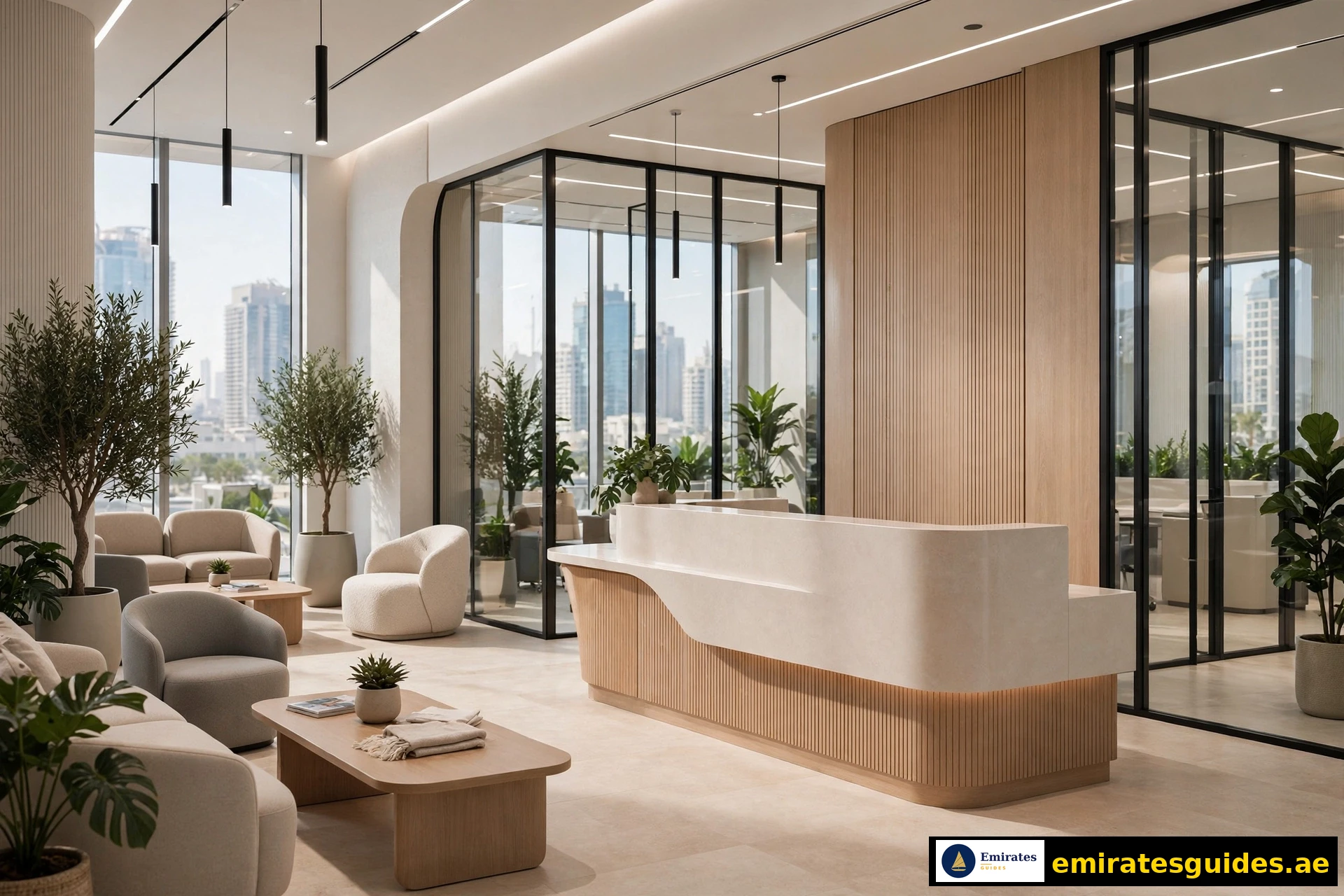
DHA categorises health facilities. Your clinic type determines the licensing track, facility standards, and staffing requirements:
General / GP Clinic
- Primary care, family medicine
- Simplest licensing; lowest fit-out requirements
- Typical cost: AED 100,000–250,000 all-in
Specialist Clinics
- Dermatology, dental, paediatrics, orthopaedics, cardiology, etc.
- Each speciality has specific equipment and room requirements
- Typical cost: AED 200,000–500,000+
Day Surgery Centres
- Minor surgical procedures with same-day discharge
- Strictest facility standards: operating theatre specs, recovery rooms, emergency protocols
- Typical cost: AED 500,000–1,500,000+
Diagnostic Centres
- Radiology, pathology, laboratories
- Equipment-heavy; imaging machines drive the cost
- Typical cost: AED 300,000–1,000,000+
Wellness / TCAM Clinics
- Ayurveda, homeopathy, traditional Chinese medicine, wellness coaching
- Different activity codes (e.g. DED 9609.01 for certain wellness activities)
- Lighter medical regulation but still DHA-overseen for clinical claims
- Typical cost: AED 80,000–200,000
Choosing your type: start with what your Medical Director is qualified to lead. The director’s speciality effectively defines your clinic’s scope — you cannot open a dermatology clinic led by a GP, and DHA will reject mismatched applications.
Who Can Open a Clinic in Dubai? Eligibility
Investors (Non-Medical Owners)
- You do not need to be a doctor to own a clinic
- You must appoint a DHA-licensed Medical Director who takes clinical responsibility
- The Medical Director must be full-time at your facility
- You handle the business side; the director handles all clinical governance
Healthcare Professionals
- Doctors, dentists, and specialists can open clinics in their licensed speciality
- You can serve as your own Medical Director (if your licence category qualifies)
- Your DHA professional licence must be active and in good standing
Key Requirement for Everyone
- The facility cannot operate without a Medical Director — if the director resigns, you typically have about 2 weeks to appoint a replacement before the licence is at risk
- All practising staff need individual DHA professional licences (more on DataFlow below)
Step-by-Step: How to Open a Clinic in Dubai
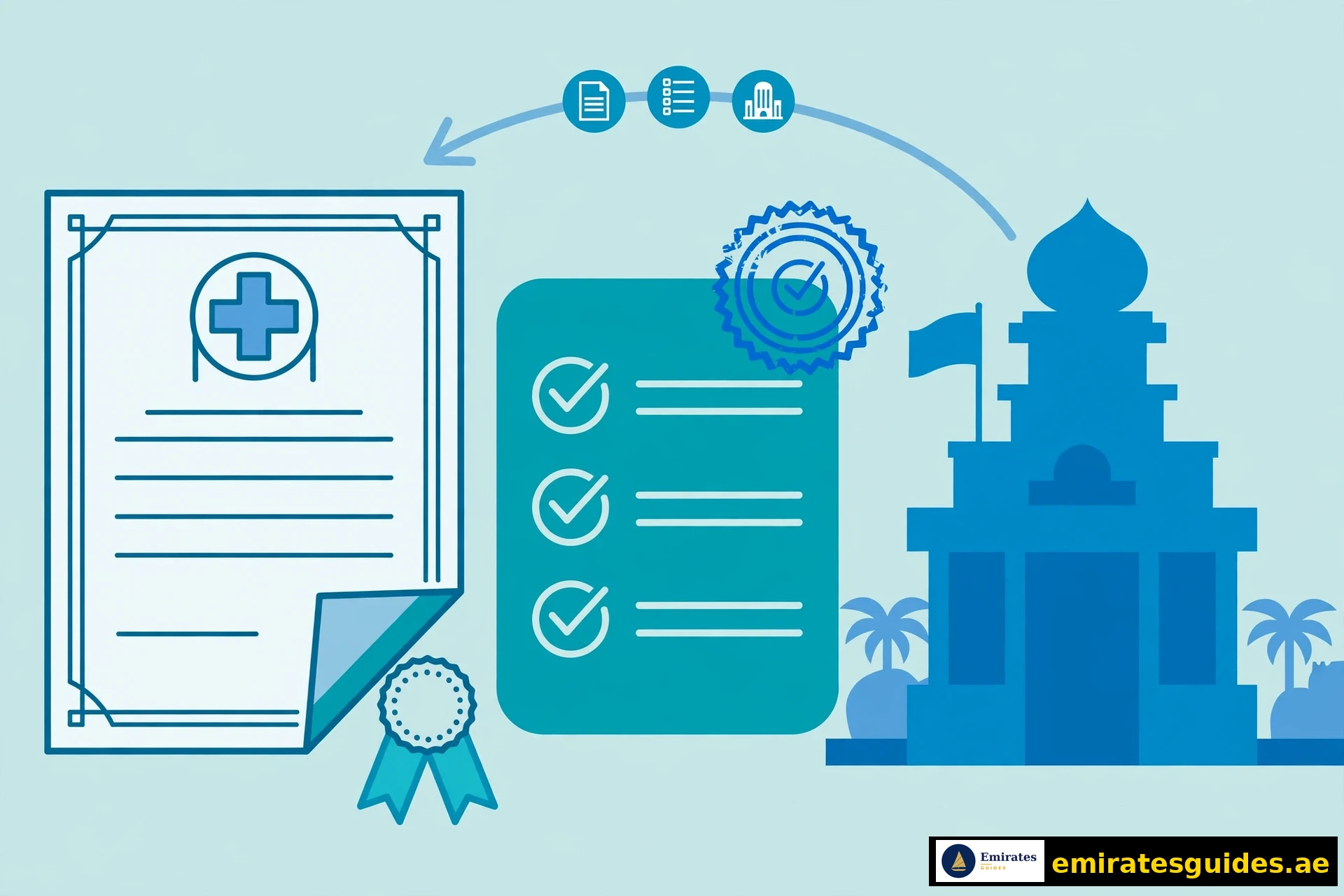
Here is the full clinic setup in Dubai process, in order:
Step 1: Define Your Clinic Concept
Decide your speciality, target patients, and services. This drives every downstream decision — location, size, equipment, staffing, and budget. Write a simple business plan; some authorities ask for it.
Step 2: Reserve Your Trade Name
Submit name options to DED/DET. Healthcare names must comply with UAE naming rules and cannot make misleading clinical claims (no “Best”, “No.1”, cure promises).
Step 3: Get DED/DET Initial Approval and Commercial Licence
The commercial licence (trade licence) is separate from the medical facility licence. You need both. The DED licence covers the business entity; DHA covers the medical activity.
Step 4: Secure Your Location
Sign a lease (Ejari-registered). DHA has minimum space and layout requirements that vary by clinic type — do not sign a lease until you have checked the facility guidelines for your category. This is the mistake that costs people the most money.
Step 5: Submit Facility Layout to DHA
Through the DHA Sheryan portal, submit your floor plans showing room dimensions, clinical vs non-clinical areas, sterilisation zones, handwashing stations, emergency equipment placement, and accessibility compliance. DHA reviews and approves (or requests changes).
Step 6: Obtain DHA Initial Approval
With layout approved, DHA grants initial approval to proceed. This is not the licence to operate — it is permission to build.
Step 7: Fit-Out and Equipment Installation
Build to the approved plans. Any deviation from the approved layout can fail the final inspection. Install medical equipment, IT systems (including NABIDH-compatible EMR), medical gases if required, and HVAC to healthcare standards.
Step 8: License Your Staff (DataFlow + DHA)
In parallel with fit-out, run every clinician through DataFlow primary source verification and DHA professional licensing. This takes 10–20 weeks — start it early or it becomes your critical path.
Step 9: Final DHA Inspection
DHA inspectors visit and check everything against the approved plans and the Health Facility Guidelines: room sizes, equipment calibration certificates, sterilisation protocols, waste management, SOPs, emergency preparedness, and staff licences.
Step 10: Receive Your Facility Licence
Pass inspection → DHA issues the facility licence. You are now legally authorised to operate.
Step 11: Post-Licence Activation
- Activate on DHA systems
- Complete insurance company empanelment (so patients can use insurance at your clinic)
- Register for NABIDH (health information exchange)
- Schedule your first DHA audit (they will come)
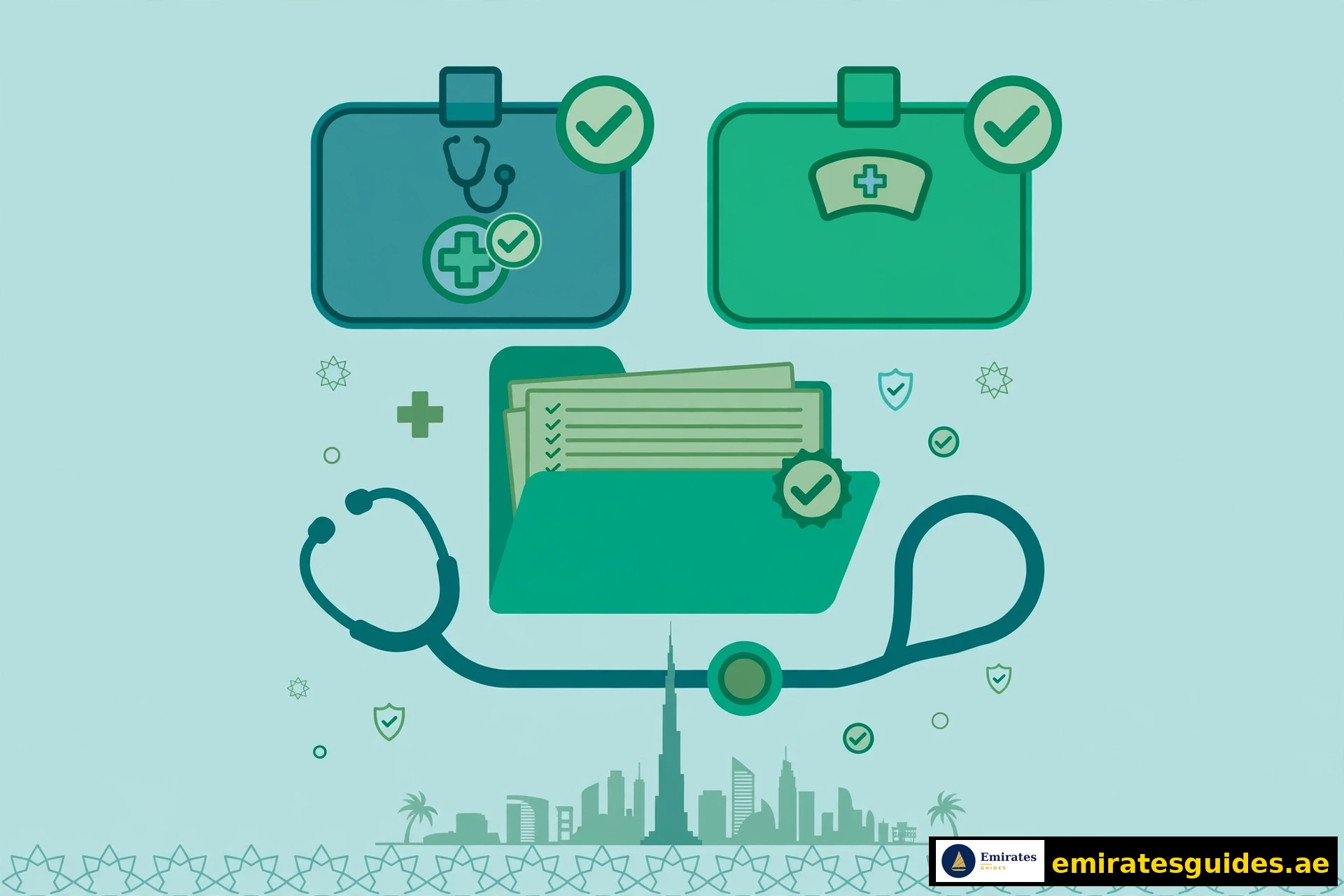
The two-application insight: DHA licensing is really two parallel tracks — the facility licence (the building, equipment, systems) and professional licences (every doctor, nurse, technician). They move at different speeds. Manage them as separate workstreams from day one.
DHA Licensing Explained: The Two Tracks
Understanding DHA’s dual system is the single most important concept in how to open a clinic in Dubai:
Track A: Facility Licensing (via DHA Sheryan Portal)
This licenses the premises:
- Initial approval application
- Layout and fit-out plan approval
- Pre-opening inspection
- Facility licence issuance
- Annual renewal with re-inspection
Track B: Professional Licensing (via DataFlow + DHA)
This licenses every person who touches patients:
- DataFlow Primary Source Verification — an independent company verifies your degrees, experience certificates, and good-standing letters directly with the issuing institutions (10–20 weeks)
- DHA professional licence application — with verified documents
- DHA exam (for most categories) — Prometric-based assessment
- Licence issuance — tied to your facility
What This Means Practically
- Start DataFlow for your Medical Director and key staff before fit-out begins
- A clinician cannot see patients until both tracks are complete
- If a staff member’s DataFlow fails (unverifiable credentials), you need a replacement — build buffer into hiring timelines
How Much Does It Cost to Set Up a Clinic in Dubai?
The question everyone asks. Here are realistic 2026 AED ranges:
Small GP Clinic (2–3 Rooms)
| Cost item | Range (AED) |
|---|---|
| Trade name + commercial licence (DED) | 15,000–30,000 |
| DHA facility licence fees | 20,000–50,000 |
| Location (annual rent, modest area) | 80,000–150,000 |
| Interior fit-out | 100,000–250,000 |
| Medical equipment & furniture | 50,000–150,000 |
| Staff licensing (DataFlow + DHA, 3–5 staff) | 15,000–40,000 |
| IT systems / EMR / NABIDH | 20,000–50,000 |
| Legal, PRO, consultancy | 20,000–50,000 |
| Marketing & launch | 15,000–40,000 |
| Working capital (3–6 months) | 100,000–200,000 |
| Total year one | ~AED 435,000–950,000 |
Wait — that is higher than the “AED 100,000–220,000” some sources quote. The difference: those lower figures typically cover licensing and setup fees only, excluding rent, fit-out, equipment, and working capital. Both are “true” — they just count different things. When comparing quotes, always ask: does this include rent, fit-out, and equipment, or just the paperwork?
Specialist Clinic (Dermatology/Dental Example)
- All of the above, plus specialist equipment (lasers: AED 150,000–400,000; dental chairs: AED 80,000–150,000 each)
- Realistic total: AED 500,000–1,200,000
Cost-Cutting Realities
- Second-hand equipment can save 40–60% — but verify calibration and DHA acceptability
- Smaller footprint in a less premium area cuts rent (the biggest fixed cost)
- Phased opening — start with core services, add specialities at renewal
- Do not cut: sterilisation, emergency equipment, or staff licensing — these fail inspections
How Long Does It Take? Realistic Timeline
Online estimates range from 25 days to 12 months. Here is the honest breakdown:
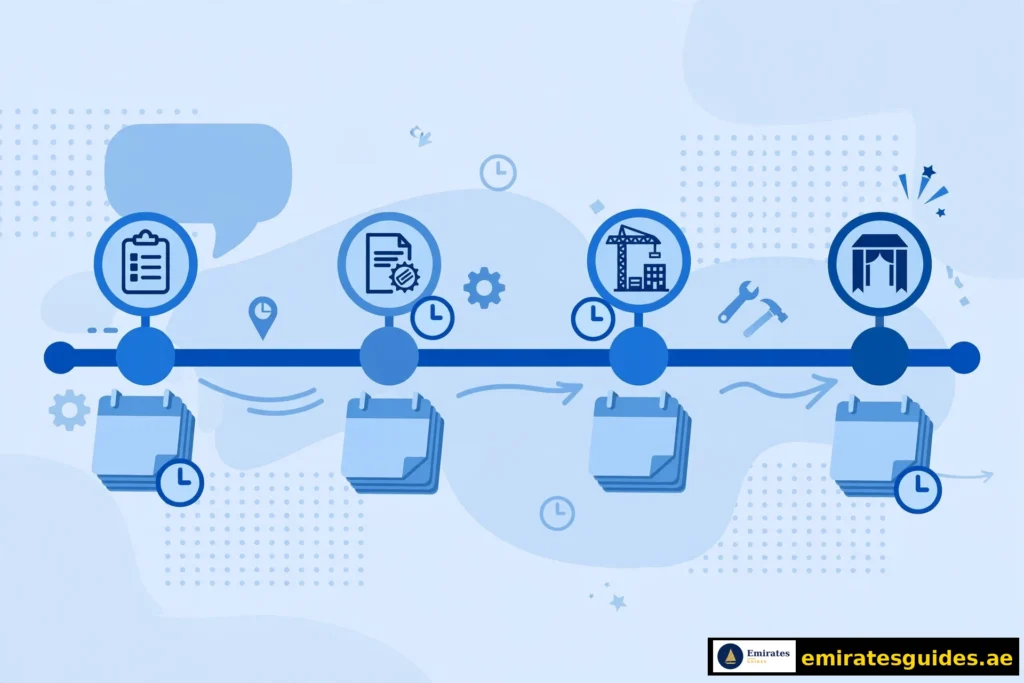
| Phase | Duration | Notes |
|---|---|---|
| Concept, planning, location search | 1–2 months | Do not rush this |
| Trade name + DED commercial licence | 1–2 weeks | Fast if documents ready |
| DHA initial approval + layout approval | 3–6 weeks | Depends on revisions |
| Fit-out construction | 2–4 months | The longest single phase |
| Staff DataFlow + licensing | 10–20 weeks | Run in parallel with fit-out |
| Equipment installation & calibration | 2–4 weeks | Overlaps fit-out end |
| Final DHA inspection + corrections | 2–6 weeks | Corrections add time |
| Licence issuance + activation | 1–2 weeks | |
| Total | 6–12 months | Realistic for most clinics |
The 25-day claims you see online refer to the commercial licence alone — not the full medical facility setup. Anyone promising a licensed, inspected, operational clinic in weeks is selling you the paperwork, not the clinic.
Critical path: DataFlow verification (10–20 weeks) and fit-out (2–4 months) are the two longest items. Start both as early as possible. Everything else fits around them.
Mainland vs Dubai Healthcare City (DHCC): Where to Set Up
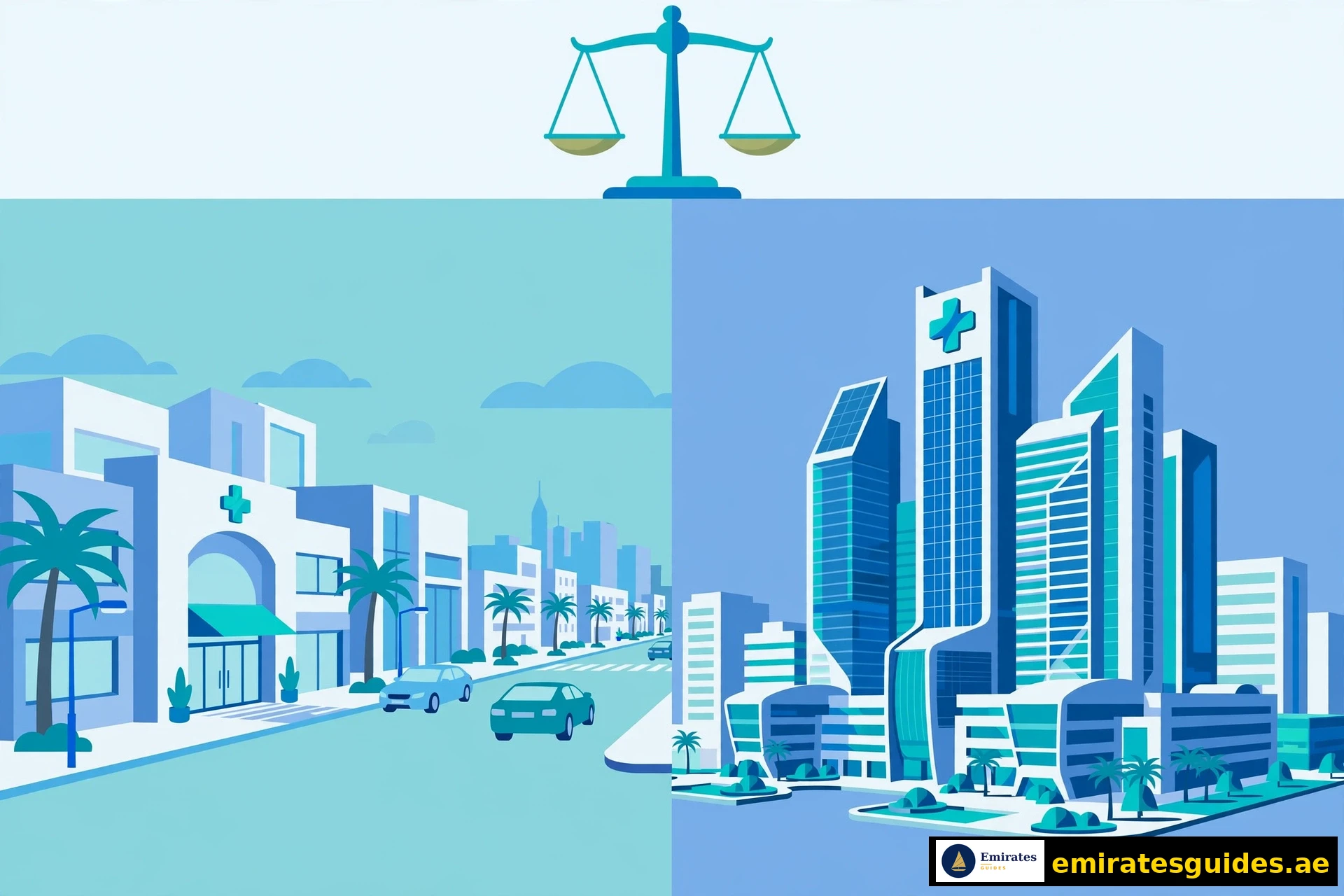
| Factor | Mainland (DHA) | DHCC Free Zone |
|---|---|---|
| Regulator | DHA | DHCR (Dubai Healthcare City Regulator) |
| Ownership | 100% foreign allowed | 100% foreign allowed |
| Minimum capital | None specified | ~AED 50,000 (commercial) / ~AED 300,000 (clinical) |
| Patient catchment | Full Dubai population | Healthcare-cluster footfall + medical tourists |
| Rent | Varies widely by area | Premium (healthcare district pricing) |
| Insurance empanelment | Standard process | Well-established with major insurers |
| Prestige | Depends on location | High — the region’s medical hub |
Choose Mainland If…
- You want a neighbourhood clinic serving local residents (Al Barsha, Marina, Deira)
- Rent budget matters — mainland offers far more range
- Your patients come from the surrounding community
Choose DHCC If…
- You want the prestige and footfall of Dubai’s medical district
- Medical tourism is part of your strategy
- Specialist or premium positioning justifies the higher rent
- You want the free zone’s streamlined processes
For most first-time clinic owners, mainland is the pragmatic choice — lower rent, wider location options, and the same DHA clinical standards. DHCC makes sense once you have the patient volumes to justify premium positioning.
Choosing Your Clinic Location in Dubai
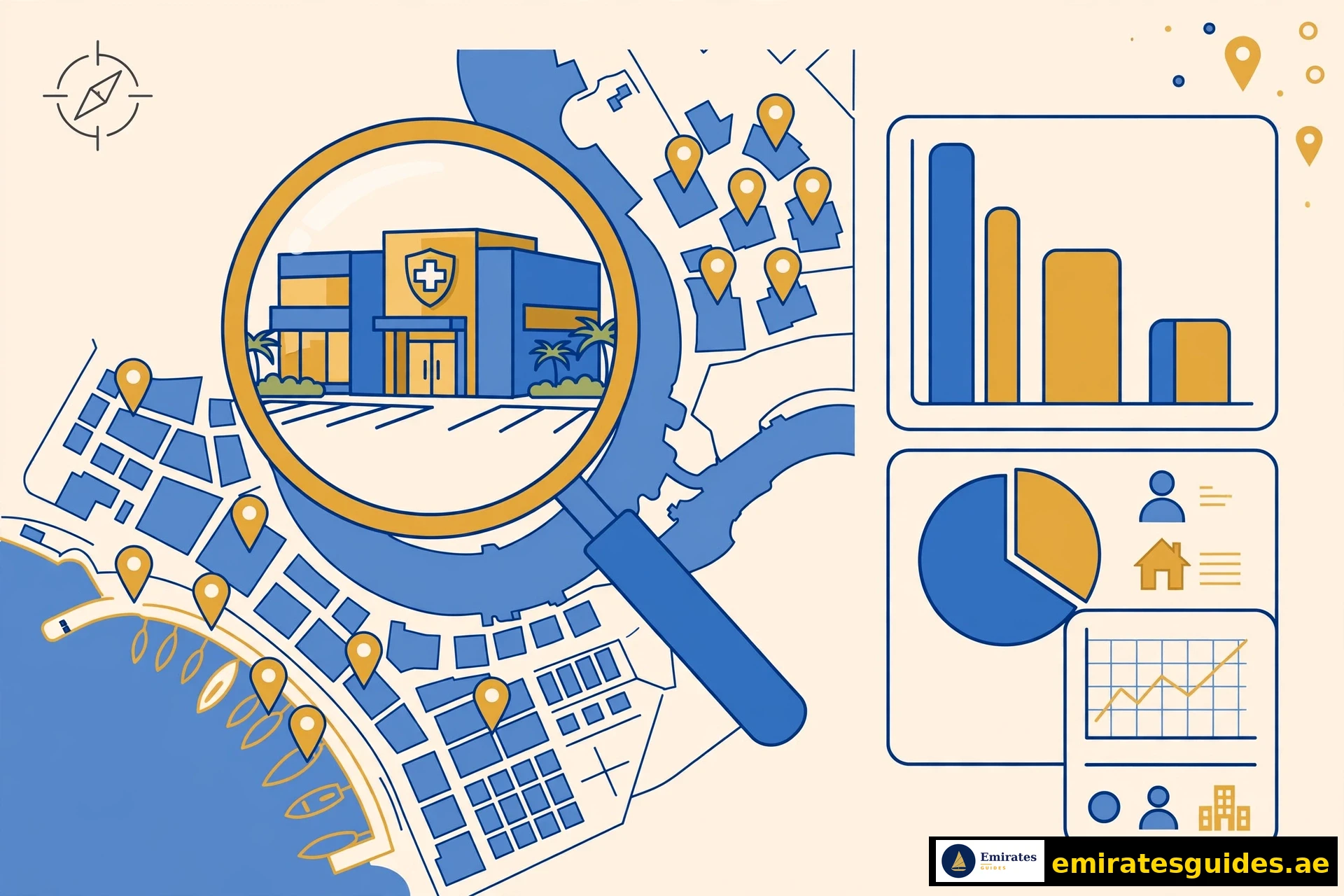
Location is a clinical and commercial decision:
What to Analyse
- Demographics — family areas need paediatrics and GP; business districts need executive health and dermatology
- Competition mapping — count existing clinics in your speciality within 3–5 km
- Traffic and parking — patients will not return if parking is a nightmare; ground-floor with dedicated parking wins
- Visibility and signage — DHA regulates healthcare advertising, but physical visibility still drives walk-ins
- Rent vs revenue — the golden rule: annual rent should not exceed 15–20% of projected revenue
Popular Clinic Districts
- JLT / Marina — dense residential, high footfall, premium rents
- Al Barsha — family-heavy, strong GP/paediatric demand, moderate rents
- Business Bay — young professionals, aesthetic and wellness demand
- Deira / Bur Dubai — high density, price-sensitive patients, lower rents
- DHCC — medical tourism and premium positioning (see above)
The Fit-Out Trap
Never sign a lease before confirming the space can meet DHA’s facility requirements for your clinic type: minimum room sizes, ceiling heights, plumbing for clinical areas, separate clean/dirty utilities, and accessibility. A cheap lease on an unsuitable space is the most expensive mistake in setting up a private clinic in Dubai.
Fit-Out and Facility Requirements
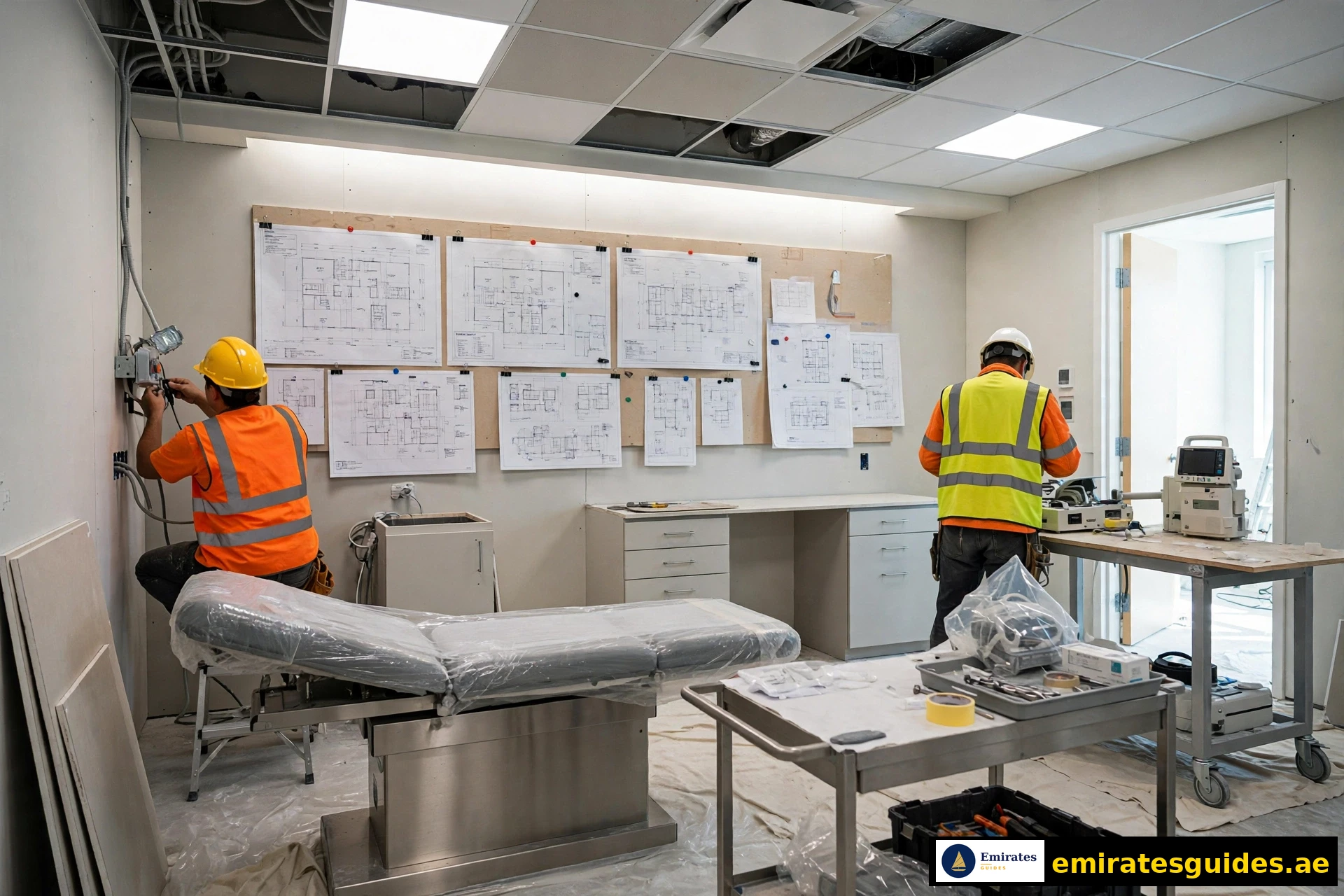
DHA’s Health Facility Guidelines specify detailed standards. Key elements inspectors check:
Layout Requirements
- Minimum room dimensions per clinic type (examination rooms, waiting areas, reception)
- Clean and dirty utility rooms — separated, with proper workflow
- Handwashing stations — in every clinical room
- Sterilisation area — with validated equipment and protocols
- Emergency equipment — crash cart, oxygen, defibrillator as applicable
- Accessibility — wheelchair access, accessible toilets, compliant door widths
Systems
- HVAC to healthcare standards (air changes, filtration, pressure differentials where required)
- Medical gases (if applicable to your services)
- IT/EMR compatible with NABIDH (Dubai’s health information exchange)
- Fire safety — Civil Defence approval is part of the process
Equipment
- All medical equipment must be registered/accepted as applicable
- Calibration certificates required — inspectors ask for them
- Maintenance contracts for critical equipment
Fit-out budget rule: AED 800–1,500 per square foot for a proper medical fit-out in Dubai. A 1,500 sq ft clinic = AED 120,000–225,000 in construction alone, before equipment.
7 Common Mistakes That Delay Clinic Openings
- Signing a lease before DHA layout approval — the space may not comply; now you are paying rent on an unusable clinic
- Starting DataFlow late — 10–20 weeks cannot be compressed; late start = delayed opening
- Underestimating fit-out time — medical fit-outs take 2–4 months; contractors who promise 6 weeks are guessing
- Deviating from approved plans — “small changes” during construction fail inspections
- Hiring unlicensed staff hoping to license later — operating with unlicensed staff risks temporary closure
- No Medical Director continuity plan — director resigns, 2-week clock starts, panic follows
- Ignoring insurance empanelment — licensed but not empanelled means cash-only patients; empanelment takes weeks to months with each insurer
After Opening: What Nobody Tells You
Getting the licence is halftime. Here is the second half:
Renewals and Ongoing Compliance
- Facility licence renewal — annual, with re-inspection
- Professional licence renewals — each staff member, with CME (continuing medical education) requirements
- DHA audits — expect them; keep SOPs, incident logs, and sterilisation records audit-ready always
- Medical waste reporting — contracted waste management with documentation
Insurance Empanelment
- Apply to major insurers (Daman, AXA, Bupa, etc.) — each has its own process and timeline
- Empanelment can take 2–6 months per insurer
- Until empanelled, patients pay cash and claim reimbursement — which suppresses volumes
Marketing (DHA Rules Apply)
- Healthcare advertising in Dubai is regulated — no misleading claims, no “best” superlatives, no before/after photos for certain procedures without compliance
- Google Business Profile, a proper website, and patient reviews are your highest-ROI channels
- Community outreach (health talks, school partnerships) builds trust faster than ads
Financial Reality Check
- Most new clinics take 12–24 months to break even
- Keep 6 months of operating costs in reserve beyond setup — this is what separates survivors from closures
- Track revenue per doctor per day from week one; it is your most important metric
Documents Checklist: Everything You Need
For the Commercial Licence (DED/DET)
- Passport copies of all owners/partners
- Trade name reservation certificate
- Initial approval
- MOA (if multiple owners)
- Lease + Ejari
For DHA Facility Licence (Sheryan Portal)
- Commercial licence
- Approved floor plans and layout drawings
- Equipment list with specifications
- Medical Director’s DHA licence and appointment letter
- SOPs and policy manuals (infection control, waste management, emergency protocols)
- Fire safety / Civil Defence clearance
For Each Clinician (DataFlow + DHA)
- Degree certificates (attested)
- Experience certificates
- Good Standing certificate from last regulator
- Passport + photo
- DHA exam (as applicable)
Start collecting on day one. Document attestation from home countries takes weeks; DataFlow verification takes months. Paperwork is the silent timeline-killer.
DHA Health Facility Categories: Which One Are You?
DHA does not license “clinics” generically — you apply under a specific facility category. Getting this right at the start prevents rework:
| Category | What it covers | Licence complexity |
|---|---|---|
| General clinic | GP / family medicine | Standard |
| Specialist clinic | Single speciality (dermatology, dental, etc.) | Standard+ (speciality equipment) |
| Polyclinic | Multiple specialities under one roof | Higher (each speciality assessed) |
| Day surgery centre | Procedures with same-day discharge | High (theatre standards) |
| Diagnostic centre | Radiology / pathology / lab | High (equipment-heavy) |
| Wellness / TCAM centre | Ayurveda, homeopathy, TCM, wellness | Moderate (different framework) |
Why it matters: each category has its own facility guidelines — minimum room sizes, required equipment lists, and staffing ratios. Applying under the wrong category means redoing your layout submission. When in doubt, describe your planned services to a DHA-licensed consultant before you apply, not after.
One-activity-per-specialist rule: in some configurations, each specialist is limited to one medical activity. If your polyclinic plans five specialities, you need appropriately licensed specialists for each — you cannot stretch one doctor across multiple scopes.
The Medical Director: Your Most Important Hire
The Medical Director is not a formality — DHA holds this person clinically accountable for everything that happens in your facility.
Requirements
- DHA-licensed physician (consultant or specialist level, depending on facility type)
- Relevant speciality matching your clinic’s scope
- Full-time commitment to your facility
- Clean professional record (DataFlow + Good Standing verified)
Responsibilities
- All clinical governance: protocols, patient safety, quality assurance
- Credentialing and privileging of every clinician
- Incident reporting to DHA
- Signing off on SOPs and clinical policies
- Being present (or appropriately covered) during operating hours
Finding One
- Doctor-owners serve as their own director (simplest path)
- Investor-owners recruit via medical recruitment agencies, professional networks, or existing contacts
- Typical compensation: AED 30,000–80,000/month depending on speciality and reputation — this is a senior hire, not an administrative checkbox
- Continuity planning: have a succession plan. If your director leaves, the ~2-week replacement clock is brutally short.
Investor tip: involve your Medical Director in the concept and layout phase, not after construction. A director who helped design the clinical workflow will run a better clinic — and DHA inspectors notice when the clinical leadership understands the facility.
Medical Equipment: Procurement Guide
Equipment is where clinic budgets explode. Buy smart:
New vs Refurbished
- New: full warranty, latest tech, DHA-friendly documentation — but 2–3× the price
- Refurbished/certified pre-owned: 40–60% cheaper; insist on calibration certificates and service history
- What to buy new: sterilisation equipment, emergency equipment, anything where failure risks patient safety
- What to consider refurbished: imaging machines, dental chairs, examination tables, furniture
Procurement Checklist
- [ ] Equipment list matched to your DHA facility category requirements
- [ ] Supplier quotes (minimum 3 for major items)
- [ ] Calibration certificates included
- [ ] Installation and training included in price
- [ ] Warranty terms in writing (minimum 1 year for major equipment)
- [ ] Maintenance contract pricing (annual — budget from year one)
- [ ] Delivery timeline aligned with fit-out completion
Common Equipment Budgets (Indicative)
| Clinic type | Equipment budget (AED) |
|---|---|
| GP clinic | 50,000–150,000 |
| Dental (2 chairs) | 200,000–400,000 |
| Dermatology (with lasers) | 250,000–600,000 |
| Diagnostic (basic imaging) | 300,000–800,000 |
| Day surgery | 400,000–1,000,000+ |
Lead times: specialist medical equipment can take 8–16 weeks from order to installation. Order during fit-out, not after — equipment delays are a classic opening-date killer.
NABIDH, EMR, and Health Tech Requirements
Dubai’s health information exchange (NABIDH) is not optional — your clinic’s systems must connect:
What You Need
- EMR system compatible with NABIDH integration
- Patient records, prescriptions, lab orders, and referrals flow through the exchange
- DHA checks IT readiness during inspection
Choosing an EMR
- Confirm NABIDH compatibility in writing from the vendor
- Cloud vs on-premise: cloud is simpler for small clinics (AED 15,000–40,000/year)
- Include training for all clinical staff in the contract
- Test the system before opening — not during your first week of patients
Beyond the EMR
- Appointment and queue management system
- Billing integrated with insurer empanelment requirements
- Backup and data protection (patient data is sensitive — have a real backup strategy)
- Website with online booking (patients expect it in 2026)
Budget: AED 20,000–50,000 for IT systems in year one for a small clinic. Under-budgeting here creates daily operational pain — this is not the place to save AED 10,000.
Frequently Asked Questions
Financing Your Clinic: Options in Dubai
Few people fund a clinic entirely from savings. Here are the realistic options:
Self-Funding
- Full control, no debt, no investor pressure
- Reality check: AED 500,000+ is a lot of personal capital to lock into an illiquid asset
- Keep 6 months of operating costs separate from setup costs — do not spend your reserve on nicer furniture
Bank Loans
- UAE banks offer SME and professional loans, but medical startups are viewed as higher risk
- Expect to show: business plan, projected cash flows, your own capital contribution (usually 30–50%)
- Interest rates: typically 6–12% for SME lending
- The clinic licence itself is not collateral — banks want personal guarantees or property
Investor Partnerships
- Common structure: investor funds setup, doctor brings licence and clinical leadership
- Get the partnership agreement right: profit share, decision rights, exit clauses, and what happens if the Medical Director leaves
- DHA does not care about your cap table — but your cap table will care about DHA timelines
Phased Investment
- Start with a lean GP/wellness setup (AED 150,000–300,000), generate revenue, then expand into specialities
- Lower risk, but slower — and refits disrupt operations
- Works best when the location has expansion space
Financial planning rule: whatever your setup budget is, add 25% contingency. In clinic projects, the contingency always gets spent — on fit-out overruns, equipment delays, or the extra 2 months of rent while waiting for inspection slots.
Staffing Your Clinic: Beyond the Doctors
Core Team for a Small Clinic
| Role | Notes |
|---|---|
| Medical Director | Mandatory; clinical governance |
| Doctors / specialists | Each needs DHA professional licence |
| Nurses | DHA-licensed; required ratios per facility type |
| Reception / front desk | Patient experience starts here |
| Clinic manager | Operations, DHA liaison, insurance follow-ups |
| Cleaner / housekeeping | Infection control trained |
Hiring Realities in Dubai
- DHA-licensed staff command a premium — a licensed nurse costs significantly more than an unlicensed one, and you cannot use unlicensed clinical staff
- Recruitment agencies charge 1 month’s salary per placement (standard)
- Start recruiting during fit-out, not after — DataFlow for each hire takes 10–20 weeks
- Retention matters: replacing a doctor means repeating DataFlow and disrupting patient continuity
Emiratisation and Labour Law
- MOHRE regulations apply to all hires: contracts, working hours, leave, end-of-service benefits
- Certain quotas and requirements evolve — check current MOHRE rules during planning
- Medical professionals on your visa need their DHA licence before they can work, even if the visa is issued
Insurance Empanelment: Getting It Right
Empanelment deserves its own section because it directly determines your revenue:
Why It Matters
- ~70%+ of Dubai’s insured population uses insurance for outpatient care
- Cash-only clinics serve a fraction of the market
- Each insurer you are empanelled with is a new patient pipeline
The Process (Per Insurer)
- Submit application with facility licence and doctor credentials
- Insurer reviews and may inspect
- Negotiate tariff rates (what they pay you per service)
- Sign agreement; get listed in their network
- Timeline: 2–6 months per insurer
Strategy
- Prioritise: apply to the 3–4 largest insurers first (they cover most of the market)
- Tariffs: new clinics get standard rates; renegotiate annually as volumes grow
- Direct billing setup: ensure your billing system handles each insurer’s claim format
- Do not wait for all insurers — open with 2–3 empanelments and add the rest while operating
Wellness Clinics: The Lighter Path
How to set up a health and wellness company or clinic in Dubai deserves special attention — it is the fastest-growing segment and the least understood:
What Counts as Wellness vs Medical
- Wellness: coaching, nutrition advice, spa therapies, yoga, meditation, general wellbeing services
- TCAM: Ayurveda, homeopathy, traditional Chinese medicine, hijama — regulated but under a distinct framework
- Medical: anything involving diagnosis, prescription, or invasive procedures — full DHA facility licensing
The Regulatory Spectrum
Wellness businesses sit on a spectrum: a yoga studio needs a standard commercial licence; an Ayurveda centre with treatments needs DHA oversight; a homeopathy clinic needs practitioner licensing. The more clinical your claims, the more regulation applies.
Why Investors Like Wellness
- Lower setup costs (AED 80,000–200,000 vs AED 400,000+ for medical)
- Faster licensing (weeks, not months, for non-clinical wellness)
- Growing demand — Dubai’s wellness market expands every year
- Easier staffing (no DataFlow for non-clinical roles)
The Catch
- You cannot make medical claims without medical licensing — “treats diabetes” on a wellness centre’s website invites regulatory action
- Insurance empanelment is limited for pure wellness
- Competition is fierce — differentiation matters more than in medical, where credentials do the talking
Bottom line: wellness is a real business opportunity with a genuinely lighter regulatory path — but “lighter” does not mean “none.” Get the activity codes and DHA position right before you invest.
Conclusion
Clinic setup in Dubai is a marathon, not a sprint: 6–12 months, serious capital, and a regulatory process with no shortcuts. But the rewards match the effort — Dubai’s healthcare market is growing, medical tourism is accelerating, and well-run clinics thrive.
The winners follow a simple formula: pick the right speciality and location, get DHA layout approval before signing anything, start DataFlow on day one, build exactly to approved plans, appoint a strong Medical Director, and keep 6 months of operating reserve. Do that, and how to set up a health and wellness company or clinic in Dubai becomes a project plan — not a gamble.
